Soccer 101
/ 10 min read
Table of Contents
Soccer is easier to enjoy once you stop trying to follow all 22 players at once. Start with five questions: Who has the ball? Which way are they attacking? Where is the space? Who touched it last? Why did the referee stop play? This guide gives you enough to answer them.
The match in one minute
- Two teams play with up to 11 players each, including one goalkeeper (守门员).
- A goal counts when the whole ball crosses the whole goal line, between the posts and under the crossbar.
- Outfield players cannot deliberately handle the ball in open play. The goalkeeper may use their hands inside their own penalty area (罚球区,常称“禁区”), with some restrictions.
- A standard match has two 45-minute halves. The clock keeps running; the referee adds stoppage time (伤停补时) for substitutions, injuries, delays, VAR (视频助理裁判) checks, celebrations, and other lost time.
- The team with more goals wins. A league match may finish level; a knockout match may use two periods of extra time (加时赛) and/or a penalty shoot-out (点球大战), depending on the competition.
The number shown for stoppage time is a minimum. A half can therefore run past 45+3 or 90+5 if more time is lost.
Formation (阵型): the team’s starting map
A formation describes the outfield players from back to front; the goalkeeper is left out of the numbers. A 4-3-3 means four defenders, three midfielders, and three forwards.
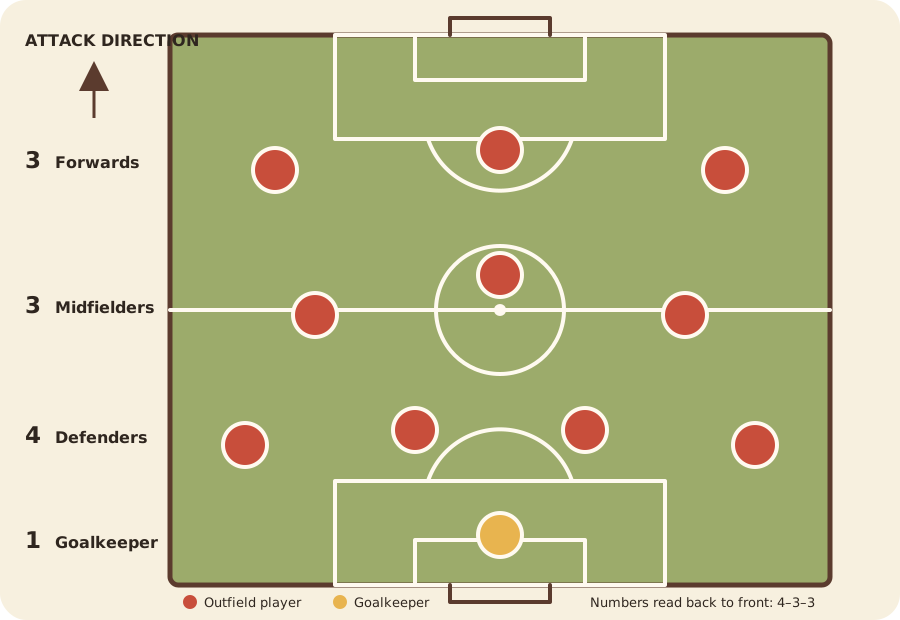
A 4-3-3 on paper. In a real match, the dots are always moving.
The four broad roles are:
| Role | What to watch |
|---|---|
| Goalkeeper (守门员) | Protects the goal and often starts attacks with passes. |
| Defenders (后卫) | Centre-backs (中后卫) guard the middle; full-backs (边后卫) or wing-backs (翼卫) cover the sides. |
| Midfielders (中场球员) | Connect the team, win the ball, and control space and tempo. |
| Forwards (前锋) | Stretch the defence, create chances, and score. |
Formations are not cages. A 4-3-3 may resemble a 2-3-5 when attacking and a 4-5-1 when defending. Read the shape as a clue to where a team wants an extra player, not as a fixed grid.
When the ball goes out: the restart map
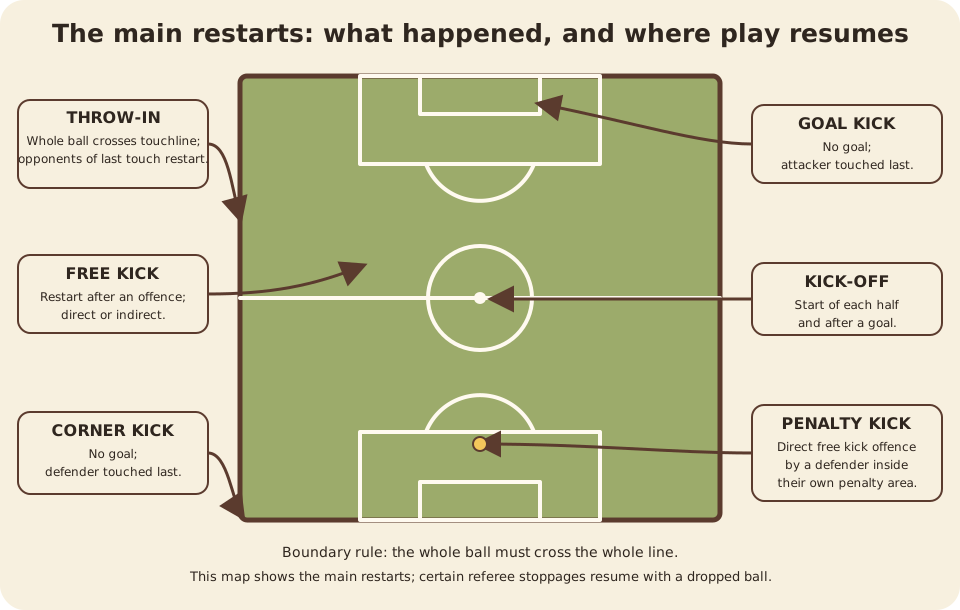
The ball remains in play while any part of it is on or above a boundary line. It is out only when the whole ball crosses the whole line, on the ground or in the air.
| What happened? | Restart |
|---|---|
| Whole ball crosses a touchline (边线) | Throw-in (掷界外球) to the opponents of the last player who touched it. |
| Ball crosses the goal line (球门线), no goal, attacker touched last | Goal kick (球门球). |
| Ball crosses the goal line (球门线), no goal, defender touched last | Corner kick (角球). |
| A goal is scored, or a half begins | Kick-off (开球) from the centre. |
| Referee stops play for a foul | Usually a direct free kick (直接任意球) or indirect free kick (间接任意球); sometimes a penalty kick (罚球点球,常称“点球”). |
| Referee stops play without an offence requiring another restart | Dropped ball (坠球). |
For a legal throw-in, the thrower faces the field, uses both hands from behind and over the head, and keeps part of each foot on the touchline or on the ground outside it.
Fouls (犯规) and free kicks (任意球)
Soccer permits contact, but not every kind of contact. Common direct-free-kick offences include careless trips, kicks, pushes, charges, and tackles, as well as holding and handball offences.
Three ideas explain most whistles:
- Direct free kick (直接任意球): the kicker may score directly. Most contact fouls produce this restart.
- Indirect free kick (间接任意球): another player must touch the ball before a goal can count. The referee holds one arm overhead. Offside (越位), playing in a dangerous manner (以危险方式比赛), and impeding an opponent without contact (无身体接触地阻挡对方队员) are common examples.
- Penalty kick (罚球点球,常称“点球”): awarded when a defender commits a direct-free-kick offence inside their own penalty area. Not every offence in the box is a penalty, and offside never produces a penalty kick.
Handball (手球犯规) is not “ball touched arm.” The referee considers whether the player deliberately moved the hand or arm toward the ball, or made the body unnaturally bigger for that action. Context matters.
Likewise, “they got the ball” is not a complete defence for a tackle. A challenge can still be careless, reckless, or use excessive force:
- Careless (草率): foul, normally no card.
- Reckless (鲁莽): foul and a yellow card (黄牌).
- Using excessive force (使用过分力量) / endangering safety: foul and a red card (红牌).
Sometimes the referee spreads both arms and calls advantage (有利原则). That means a foul occurred, but stopping play would hurt the fouled team more than letting the attack continue. A card can still be shown at the next stoppage.
Offside (越位), without the fog
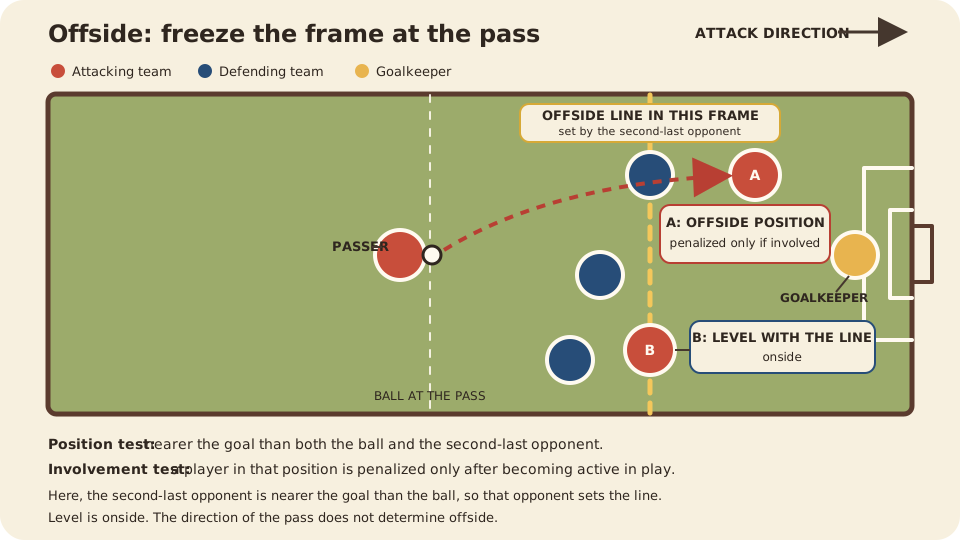
Offside is a two-step decision: position (是否处于越位位置), then involvement (是否参与实际比赛).
Step 1: freeze the picture (定格画面)
At the instant a teammate plays or touches the ball, an attacker is in an offside position (越位位置) if:
- part of their head, body, or feet is in the opponents’ half; and
- that part is nearer the goal line than both the ball and the second-last opponent (倒数第二名对方队员).
Hands and arms do not count. A player level with the second-last opponent is onside (不越位).
Step 2: wait for involvement (判断是否参与实际比赛)
Simply standing in an offside position is not an offence. The player is penalised only after becoming involved in active play (参与实际比赛)—for example by playing the ball, challenging an opponent, blocking a defender’s view, or gaining an advantage from a rebound or save.
Three useful shortcuts:
- Judge the runner when the teammate plays the pass, not when the runner receives it.
- The direction of the pass is not the rule. The attacker’s position relative to the ball and second-last opponent is what matters.
- There is no offside offence when receiving the ball directly from a goal kick, throw-in, or corner kick.
The restart for offside is an indirect free kick (间接任意球). In matches using VAR (视频助理裁判), an assistant referee (助理裁判员) may delay a close flag until the attack finishes; the late flag does not mean the rule changed mid-play.
Cards (红黄牌) and VAR (视频助理裁判)
A card disciplines the player; the free kick or penalty restarts the match. They answer different questions, so a foul can bring no card, a yellow, or a red.
- Yellow card (黄牌): a formal caution (警告)—for example for a reckless foul, stopping a promising attack, persistent offences, dissent, simulation, or delaying a restart.
- Second yellow card (第二张黄牌): results in a red card, and the player is sent off (罚令出场).
- Red card (红牌): immediate dismissal for offences such as serious foul play (严重犯规), violent conduct (暴力行为), or denying an obvious goal-scoring opportunity (破坏明显进球得分机会) in certain circumstances. The team continues with one fewer player and cannot replace the player sent off.
A video assistant referee (视频助理裁判,VAR) is used only in competitions that provide it. Most checks happen quietly. VAR generally assists with match-changing decisions involving goals, penalties, sending-offs, and mistaken identity; the referee makes the final decision. Do not expect VAR to re-referee every ordinary foul or throw-in.
How to read the match, not just the ball
Once the rules feel comfortable, use these broadcaster’s cues:
- When possession is settled, look at team width. The attacking side usually spreads out to create passing lanes; the defending side becomes compact to protect the centre.
- After possession changes, watch the first few seconds. Does the new attacking team counterattack (反击) quickly, or keep the ball and reset? Does the team that lost it press immediately, or retreat?
- Notice the spare player. If two defenders follow one attacker, somebody else may be free. Many chances begin with that small imbalance.
- Watch the space behind advancing players. An overlapping full-back adds an attacker but leaves room for a counterattack.
- Treat set pieces as rehearsed plays. Corners and free kicks are planned movements, screens, runs, and deliveries—not pauses before the “real” game resumes.
Commentary phrases worth knowing
| Phrase | Plain-English meaning |
|---|---|
| The box (禁区) | The penalty area. |
| Final third (进攻三区) | The attacking third of the pitch, nearest the opponents’ goal. |
| Press (逼抢) | Close down the player with the ball and nearby passing options. |
| Low block (低位防守) | Defend compactly and deep near your own goal. |
| Transition (攻防转换) | The moments immediately after possession changes. |
| Through ball (直塞球) | A pass into space behind the defence for a runner. |
| Switch of play (大范围转移) | Move the ball quickly from one side of the pitch to the other. |
| Overlap (套边插上) | A supporting player runs around the outside of the ball carrier. |
| Set piece (定位球) | A planned restart, especially a corner or free kick. |
| Clean sheet (零封) | Conceding no goals. |
| Counterattack (反击) | Attack quickly after winning possession. |
The five-question cheat sheet
When something confusing happens, ask:
- Did the whole ball cross a line?
- Who touched it last?
- If there was a foul, where did it happen?
- For offside, where was the runner at the teammate’s touch, and did they become involved?
- Is the referee’s arm overhead? If so, it is an indirect free kick.
That is enough to follow most of a match. The rest—the pressing traps, rotations, decoy runs, and tiny battles for space—is where watching becomes addictive.
Rules and further reading
The primary rules reference is the International Football Association Board’s current Laws of the Game: players, match duration, ball in and out of play, goals and match outcomes, offside, fouls and misconduct, free kicks, penalty kicks, and the VAR protocol.
For other beginner-friendly presentations, see Billerica Youth Soccer’s Soccer 101 and Red Bull’s beginner’s guide. Competition rules and youth modifications can differ, so use the IFAB text for the current general law.